
KODO “LUMINANCE” PROGRAMME TIDBITS
 Post
PostCollaboration Magic Condensed into E from “Oni”
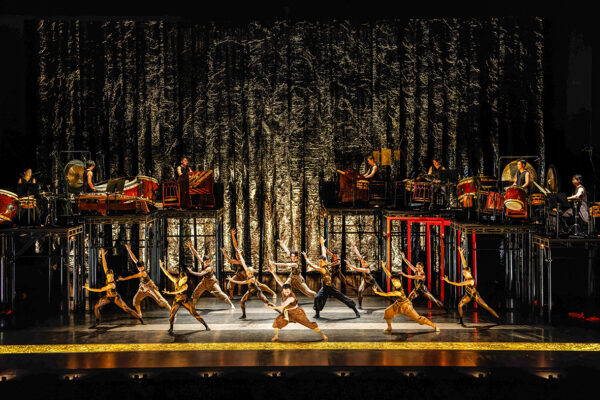
Noism × Kodo “Oni”(2024) Photo by Yuichi Kayano
Kodo and Noism Company Niigata are contemporaries from the same home prefecture who represent this region and Japan on the global stage. In 2022, the two ensembles came together for the first time to create a new touring production: Noism x Kodo “Oni.” This collaboration melds dance by Noism—directed and choreographed by Jo Kanamori—with music specially composed by Keiko Harada and performed by Kodo. The dance and music portray the natural and spiritual features of the troupes’ homeland Niigata. The result is a vivacious cutting-edge work. In LUMINANCE, Kodo will perform a mere minute of the introduction to Oni, using this moment to set the scene for its signature piece Monochrome. E from Oni plays an important role, dramatically heightening the tension in the auditorium before the audience enters the world of Monochrome. Come and experience this magic minute and the legendary masterpiece that follows firsthand.
Monochrome Turns 50
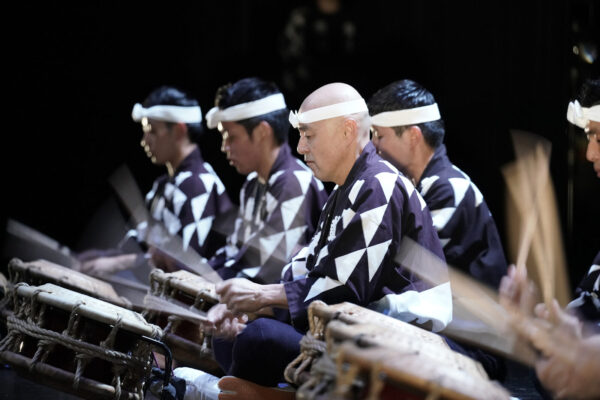
Photo by Takashi Okamoto
Monochrome is performed using ten taiko drums—seven shime-daiko and three miya-daiko—and two large, deeply resonant gongs. Taiko are primarily used to create loud sounds, yet this piece shows how you can harness the utmost restraint to create a broad spectrum of sound: from barely audible taps to formidable thunderous claps. The title of this opus sets the expectations of simplicity before painting a mind-bending rainbow of sound.
Its 1976 premiere floored the audience with its combination of traditional instruments and a truly modernistic approach. Monochrome has stood the test of time, captivating people all over the world for five decades and counting with its unwavering power. In LUMINANCE, Kodo celebrates this unparalleled composition that remains at the heart of the ensemble’s repertoire.
How Monochrome Came to Be
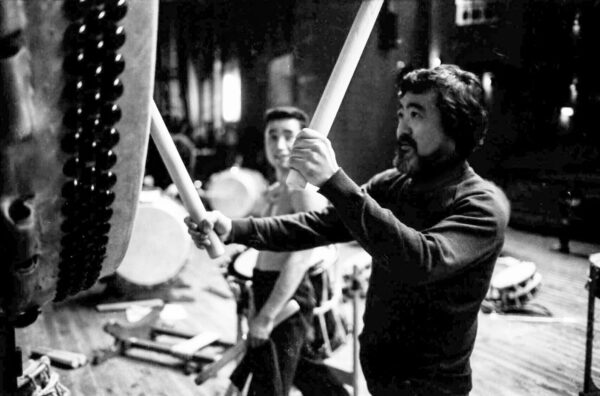
Maki Ishii (1980s)
In 1975, Maki Ishii, a Japanese composer of contemporary classical music, traveled to Sado Island on the strong recommendation of conductor Seiji Ozawa, who had seen Kodo’s antecedent group Sado no Kuni Ondekoza perform in Boston in April that year. In the months that followed his first encounter with the group, Ishii made several trips to Sado, spending time with the Ondekoza members and learning about various ways of playing Japanese taiko drums. He drew on this experience to compose two pieces: Monochrome for the taiko ensemble alone, and a collaborative work for taiko and orchestra, Mono-Prism. Ondekoza premiered Monochrome in February 1976 in Tokyo at a Japan-Germany Modern Music Festival. Then in July, they appeared at Tanglewood Music Festival in the USA for the debut performance of Mono-Prism with the Boston Symphony Orchestra, conducted by Ozawa. This reverberant modern music performance was met with the highest acclaim and went on to receive the 1977 Otaka Prize.
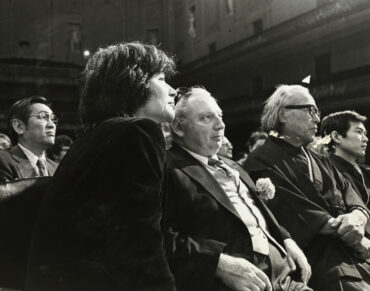
Seiji Ozawa watching Ondekoza concert in Boston