
“Anticipating New Phases as Kodo Delves Deeper” By Composer Keiko Harada
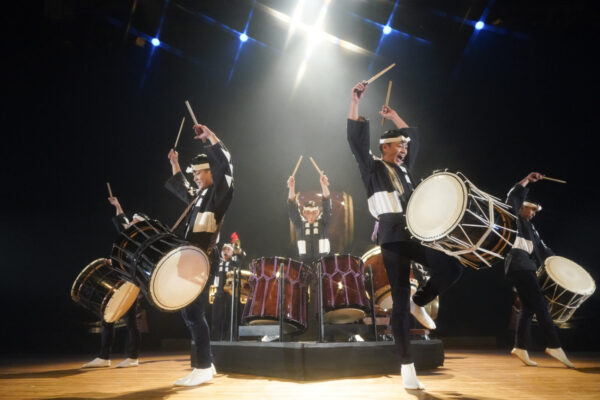
Kodo One Earth Tour 2025
Photo: Takashi Okamoto
Energetic stage performances where talented individuals shine, glistening sweat, beaming smiles, a few words to address the audience, joy and excitement, and applause. Yes, that must be the appeal of the beloved Kodo ensemble, which has captivated fans all over the world for decades. That is what I have felt watching them perform on their Japan tours in recent years. Their usual productions are, however, completely different from the first performance I collaborated on with them. I composed the eponymous piece for Noism x Kodo “Oni,” the 2020–22 work commissioned by Niigata City Art & Culture Promotion Foundation and directed and choreographed by Jo Kanamori. Kodo’s performances are delightful by nature. And, to tell the truth, ever since the new production they created immediately after “Oni,” I’ve noticed something: a certain freshness and a different kind of depth to their works. I hear it in the details, such as the resonance and ma—the Japanese feeling of space—they create in the music. I wonder if Kodo’s fans can feel that, too.
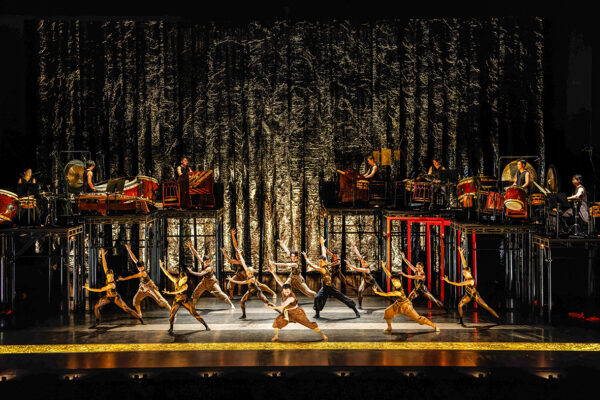
Noism × Kodo “Oni”(2024)
Photo: Yuichi Kayano
In this essay, I want to talk about two pieces that Kodo will reprise during its 2026 tours. One is Monochrome, which was composed in 1976 by Maki Ishii (1936–2003) and premiered by Kodo’s precursor that same year in Berlin. The other is Oni, which I composed in recent years for the group. I also want to share what I anticipate from Kodo.
Now, fifty years have passed since Kodo’s antecedent group, Sado no Kuni Ondekoza, performed Monochrome for the very first time in 1976. I wonder what kind of significance this composition holds for Kodo today. I think about its composer, Maki Ishii. In the mid-seventies, Japan’s composers were particularly active during a time of economic growth. Ishii traveled back and forth between Germany and Japan and became a key figure in sharing Europe’s popular “avant-garde” with Japan. That being said, Ishii himself was a dynamic, distinctive composer with a style that differed from the so-called Western avant-garde: his style had a certain primal, austere quality, close to that of a natural phenomenon. Played by seven people, Monochrome is an ambitious masterpiece that I can’t help but think is the result of what Ishii felt over fifty years ago when he first met Kodo’s precursor, Ondekoza—all condensed into one piece. Incidentally, there were no other pieces at the time that were composed especially for Ondekoza. It’s no wonder, considering it was a group centered around wadaiko [Japanese drums] that was heading in a new direction, away from simply upholding regional folk performing arts. Back then, generally speaking, people thought of it as a group that ran 20 km a day for physical training and played taiko loudly, hammering out beat after beat.
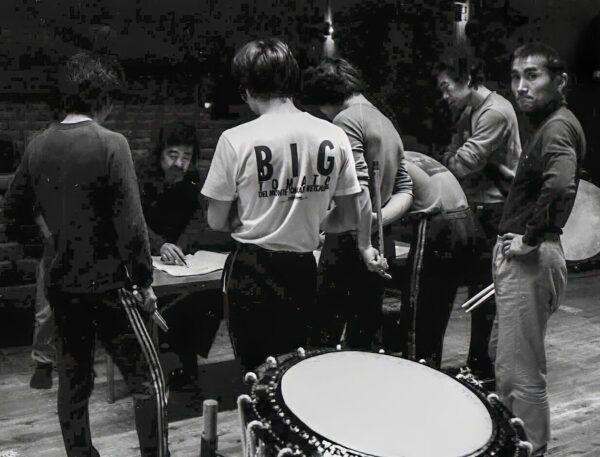
“Kaguyahime” rehearsal in Iruma, 1983
By contrast, Monochrome starts with sounds that are barely audible: a sole performer playing the beats quickly on a shime-daiko [small roped drum]. The piece progresses with the remaining six performers gradually joining the initial soloist, one by one, all playing the exact same rhythm rapidly in unison, layering the beats upon one another. After the seven performers unite to play in sync, they spend almost 30 seconds gradually increasing the force of each strike, intensifying the beats until they reach fortississimo (fff). I can feel Ishii’s aesthetics and bold attempt here. According to Ishii’s website*, “He devised a completely new way of playing taiko for them and demanded that they practice this new drumming method until it became their flesh and blood. The initial training was rigorous and strict. […] It was much like the practice of a Buddhist truth seeker. The result […] was hard to believe and led to a performance with extraordinary precision and dynamism. […]”
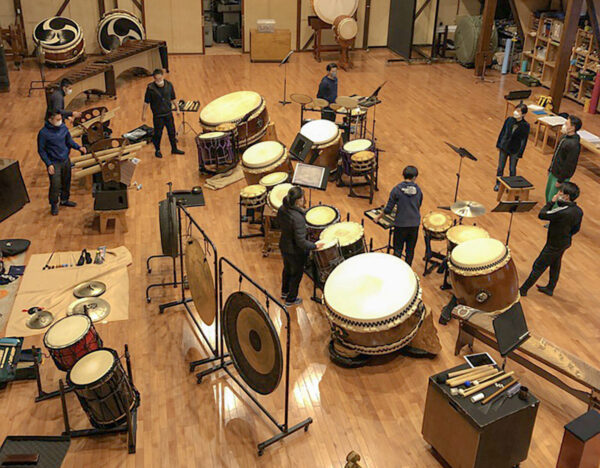
“Oni” rehearsal on Sado Island, 2021
Reading these words, I recalled the creation process of the piece that I composed for Kodo, Oni. Composer Maki Ishii required Kodo to carry out special training, and some 45 years later, when it came time to play my piece, the Kodo performers invented their own etude for the composition, which they practiced before every rehearsal. When I asked them their reason for doing that, the leader for the premiere performance calmly replied, “It’s our first time playing a piece like this. So it’s to heighten our concentration right before we play the first beat.” I was deeply impressed. One of the most distinct characteristics of my music is the sense of a sign that something is coming—an omen. So it is important that you decisively control the energy within your body until right before you make a sound. It was our first collaboration, and Kodo had already grasped the characteristics of the music I compose with sincerity, sensitivity, and intuition. Incidentally, before I composed Oni, I visited Kodo Village on Sado Island. When I heard Kodo perform in close proximity, I sensed they were a group with great potential—but that they might only be using around 20% of their potential. Also, the director and choreographer Jo Kanamori said, “I want to hear something different from anything I’ve heard Kodo play before.” From the mid-nineties onwards, whenever I want to attempt something new, I think the first thing that needs to happen is for the music medium (the performers themselves) to change internally. Otherwise, it tends to become a superficially interesting sound and display of skill, which doesn’t convey actual newness to the audience. That’s how I have composed pieces to date. So with Oni, I wanted to create the kind of music that would change Kodo on the inside. Several months after completing the piece, they delivered a performance that far exceeded my expectations, and Oni left my hands and became part of Kodo, internalized and played in their own way. That’s how it felt. Such a joyous occurrence seldom happens in the life of a composer.
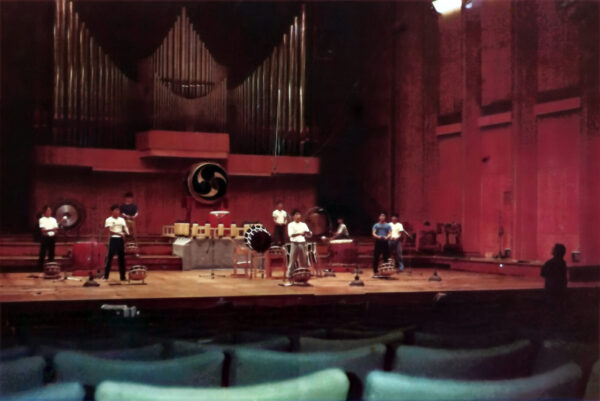
“Dyu-Ha” rehearsal in Cologne, 1981
Photo: Kazuaki Tomida
And just like that, I’m drawing to the end of this essay. In 1981, Maki Ishii gifted one of his works, Dyu-Ha, to Kodo to celebrate the founding of the group. On his website, there is a section about the piece, which says:
“Dyu-Ha means to enter new territory, and in gagaku [Japanese court music], it denotes a kind of transition format [used to change the melody]. […] To celebrate the newly formed Kodo, and entreat them to take flight, I designed a piece that would usher them into a new world of taiko, something different from what I had written to date—Monochrome and Mono-Prism.”
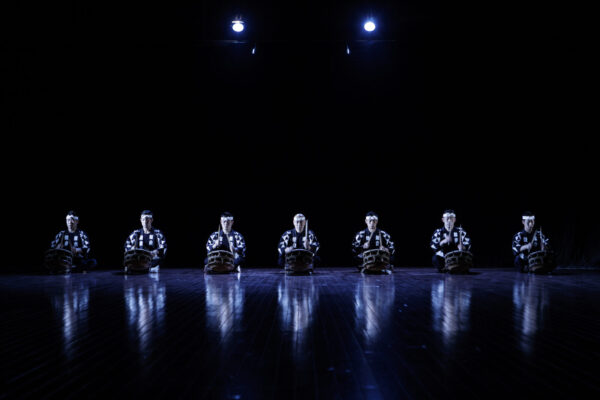
Monochrome
Photo: Takashi Okamoto
On that day when I witnessed the etude for Oni that Kodo created, I sensed that Ishii’s hopes had been handed down to the Kodo of today. Their performance skills are highly refined, to the degree that they could probably memorize and play a percussion piece composed by Iannis Xenakis, for instance. However, I personally don’t want to create music that showcases dazzling performance technique. I would like to try to create music that takes Kodo’s musical physicality to more profound levels. Generations of composers have been spurred on by their encounters with wonderful performers who are their contemporaries. These encounters motivate them to create high-quality music. Nowadays, we have entered the age of AI, and music has changed remarkably. Even so, people can still do things AI cannot. Performers can tune in to the subtle movements and changes within themselves and listen to themselves and others as they perform. When performers do that and play music with their body and soul, they create resonant sound that AI cannot imitate. So my wish is this: to create music that sounds fresh and new even 100 years from now. I anticipate that Kodo will continue to delve deeper and break new ground.
November 16, 2025
Tokyo, Japan
*Translator’s Note: This essay was written in Japanese with quotes from the Japanese pages of Maki Ishii’s website. These quotes do not appear on the website’s English pages.
| Keiko HARADA Composer Keiko Harada is honing her unique composition theory, focusing on the intrinsic state of musicians when they play music. In 2012, she started to create works based on her research. In one of her projects, Traditional Body, Creative Breathing, Harada draws on her fieldwork about regional Japan’s instruments and vocals to share Japan’s distinct regional sound culture through new forms of resonant sound and physical expression. As part of this work, she collaborated with people who uphold the tradition of Kagoshima’s Satsuma biwa [lute] to compose and premiere a new song for the instrument for the first time in around 130 years. Harada also participates in many collaborations with diverse disciplines. In 2019, she created a new work with choreographer Jo Kanamori as an appointed composer for the 9th Theatre Olympics. In 2022, Harada composed music for Oni, a collaborative work featuring taiko ensemble Kodo and dance company Noism, for which Kanamori serves as artistic director. She has received numerous awards to date, including First Place in the Japan Music Competition, the Yasushi Akutagawa Suntory Award for Music Composition, the Kenzo Nakajima Music Award, the Otaka Prize, and the Kagayaku Josei [Shining Woman] Award from Soroptimist International Kagoshima. Harada currently serves as a Professor of Composition at the Tokyo College of Music, a Visiting Professor at Kagoshima University, and a Visiting Researcher at the International Center for Island Studies at Kagoshima University. https://www.tokyo-concerts.co.jp/artists/keiko-harada/ |